Nanitor Archival Policy
Introduction
Nanitor archives assets that stop reporting. An asset is archived either automatically by an archival rule, or after you confirm its archival.
- Archival rules define how many days of inactivity an asset of a certain type, or with certain labels, may have before Nanitor archives it automatically.
- Pending archival is the state of an asset that has been inactive for 7 days and matches no archival rule. Nanitor does not archive such an asset until you confirm it.
An asset is inactive when it has not reported through its agent, a collector, or network discovery (if network discovery is enabled for the organization).
For the reference description of the settings, see Organization Management in the User Guide.
Configuring archival rules
Archival rules are managed by users with the Manage organization permission. Every organization starts with two rules: assets of type Rogue are archived after 7 days of inactivity, and assets of type Laptop after 14 days. You can edit, reorder or remove them like any other rule.
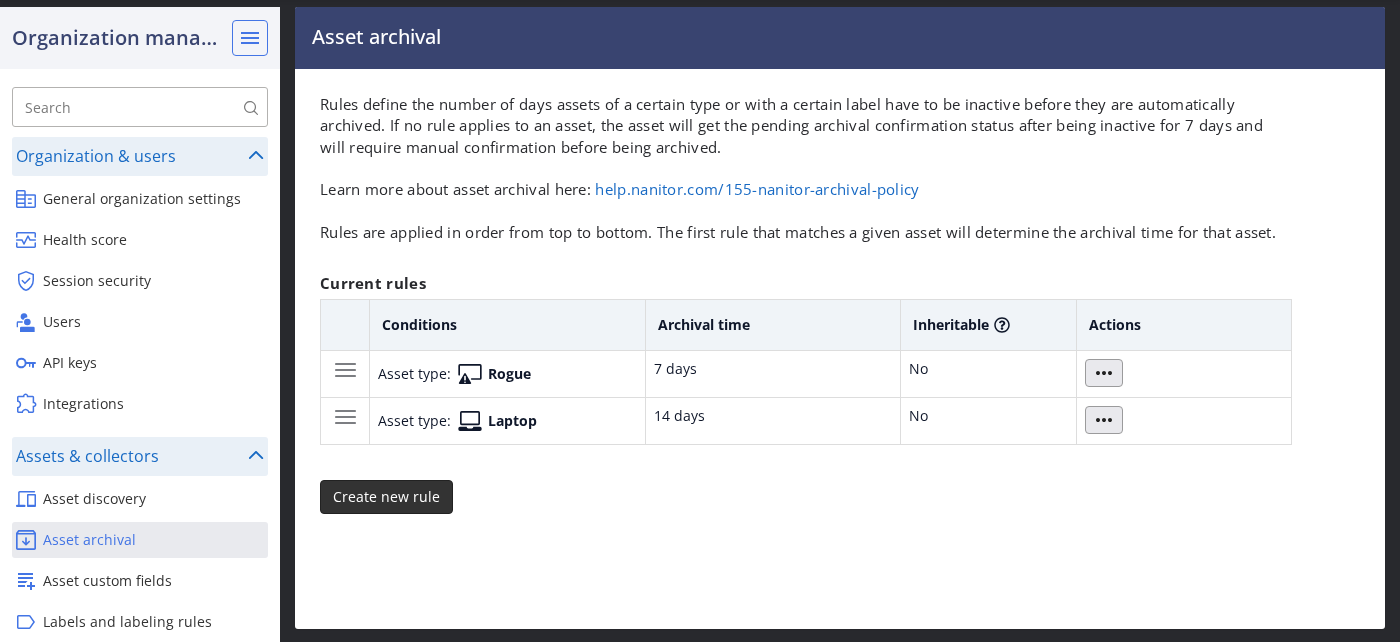
- Select the gear icon in the top-right corner, then Organization management, and select Asset archival in the Assets & collectors group.
- Select Create new rule.
- Under Conditions, choose Asset type is... or Asset label is..., then select the asset type or one or more labels.
- Under Archival time, choose the number of days of inactivity after which assets matching the rule are archived.
- Review the Affected assets list at the bottom of the dialog. It shows the assets that currently match the rule.
- Select Save. To change a rule later, open its Actions menu and select Edit. In the Edit rule dialog, select Confirm to save.
The available archival times are 1, 2, 7, 14, 30, 60 and 90 days, and Custom. Select Custom to enter any whole number of days from 1 to 365. A new rule starts at the default archival time of 7 days. A rule that uses a value that is not in the list opens with Custom selected.
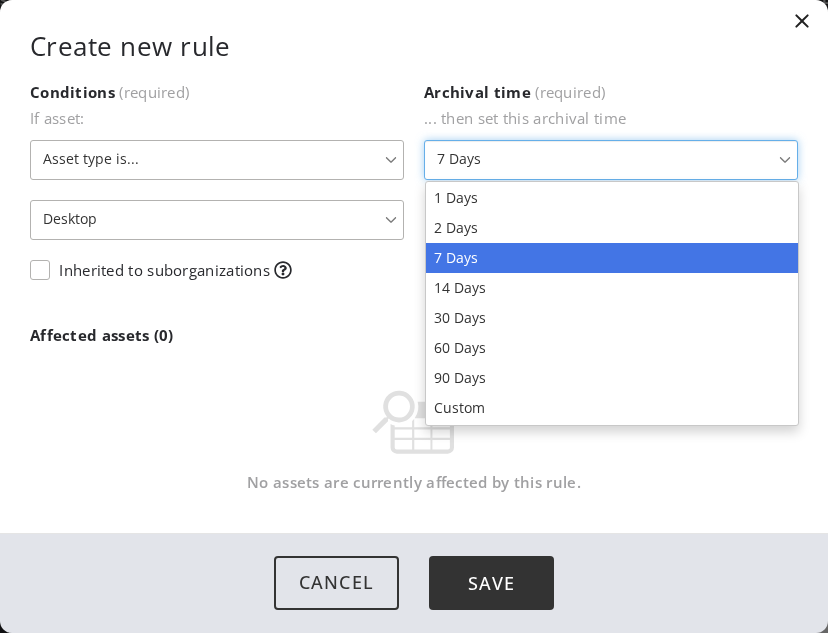
A rule with several labels matches only assets that have all of those labels.
To remove a rule, open its Actions menu, select Remove, and confirm. Assets that matched the rule are then handled as described in Assets that match no rule.
Rule order
Rules are applied from top to bottom, and the first rule that matches an asset sets that asset's archival time. A new rule is added at the top of the list. Drag the handle at the start of a row to reorder the rules. Place more specific rules above more general ones.
For example, to archive laptops after 14 days but keep servers for 90 days, create one rule for the asset type of laptops with 14 days and one for the asset type of servers with 90 days. If a rule for a label is placed above these two, an asset with that label follows the label rule even if it is a laptop or server.
Suborganizations
In a top-level organization, the Inherited to suborganizations option on a rule applies the rule to all suborganizations. Inheritable rules take priority over the rules of a suborganization. A suborganization lists inherited rules under Parent rules, where they can be viewed but not edited. To make a rule inheritable, you need an inheritable role in the organization, which is a role that also applies in its suborganizations (see User management). An inheritable rule can only use inheritable labels.
Assets that match no rule
If no rule matches an asset, the asset becomes pending archival after 7 days of inactivity. This 7-day period is fixed and cannot be changed on the Asset archival page. To archive such assets automatically, create a rule for them.
Confirming pending archival
Users with the Manage assets permission can confirm archival. Nanitor also sends a notification, shown under the bell icon, when assets are pending archival. Open Inventory > Assets, open the Asset state filter, select Pending Archival and select Apply.


Then select those assets you wish to archive by placing a mark in the checkbox next to them

Then open the Actions menu (the three dots next to the total in the upper right), select Confirm archival, and select Confirm in the dialog.


To confirm just a single asset, scroll all the way to the right to the Actions column, open the menu for the asset, select Confirm archival, and select Confirm in the dialog. You can also select Confirm archival from the asset details page.

How archived assets behave
Automatically archived and confirmed assets are both archived, which removes the asset from the default Asset Inventory view and resolves all issues found on it. They differ when the asset reports again:
- Archived by a rule: If the asset checks in again, Nanitor restores it automatically.
- Archived through Confirm archival or Archive asset: Nanitor treats the asset as manually archived. If it checks in again, Nanitor flags it with a warning that a manually archived asset is checking in. The asset stays archived until you restore it with Restore asset in the asset details.
An asset that is pending archival and starts reporting again before you confirm it leaves the pending archival state on its own.
You can find archived assets in Inventory > Assets by setting the Asset state filter to Archived.
For the meaning of each asset state, see Assets in the User Guide.